
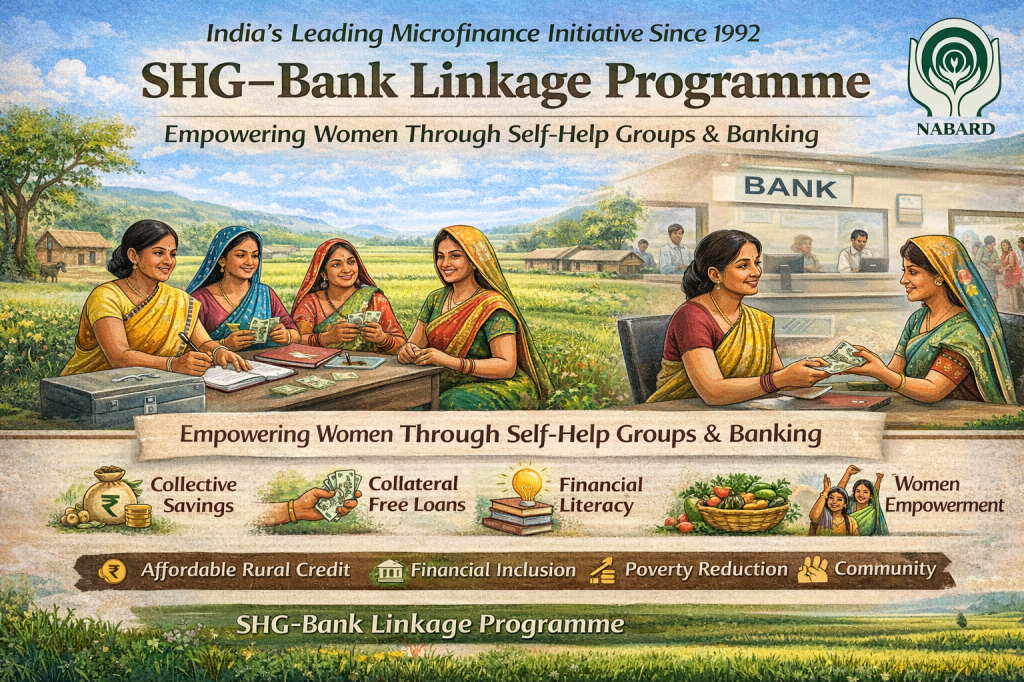
An Academic Analysis of India’s Community-Based Microfinance Model
The Self-Help Group–Bank Linkage Programme (SBLP) represents one of the most significant innovations in microfinance and rural development in India. Initiated in 1992 by the National Bank for Agriculture and Rural Development (NABARD), the programme was designed to integrate informal savings groups of the rural poor with the formal banking system. Over three decades, it has evolved into the world’s largest community-based microfinance initiative, significantly advancing financial inclusion, women’s empowerment, and poverty alleviation. This essay critically examines the origins, institutional framework, operational mechanisms, impact, and challenges of the SHG–Bank Linkage Programme in the context of India’s development trajectory.
Historical Context and Rationale
Prior to the 1990s, access to institutional credit in rural India was limited, especially for marginal farmers, landless laborers, and women. Despite nationalization of banks and priority sector lending mandates, structural barriers persisted. Rural poor households relied heavily on informal moneylenders who charged exorbitant interest rates. Formal banking institutions, on the other hand, perceived lending to the poor as risky due to lack of collateral, irregular income streams, and high transaction costs associated with small-value loans.
Against this backdrop, NABARD initiated a pilot project in 1992 to test whether informal Self-Help Groups (SHGs) could serve as intermediaries between banks and the rural poor. The programme was supported by policy encouragement from the Reserve Bank of India (RBI), which allowed banks to treat SHG lending as part of priority sector obligations. The core premise was that group solidarity, peer monitoring, and collective savings could reduce default risk and transaction costs.
Concept and Structure of Self-Help Groups
A Self-Help Group typically consists of 10 to 20 members, predominantly women from economically homogeneous backgrounds. These groups function on principles of regular savings, internal lending, democratic decision-making, and mutual accountability. Members contribute small savings periodically, which are pooled to create a common fund. Loans are initially provided from this internal corpus before the group seeks external credit from banks.
The SHG model rests on social capital rather than physical collateral. Peer pressure and collective responsibility act as mechanisms of credit discipline. This approach transforms borrowers from passive recipients of credit into active participants in financial management, thereby enhancing financial literacy and self-reliance.
Institutional Models of SHG–Bank Linkage
Over time, three primary models of linkage have emerged:
- Model I: SHGs formed and financed directly by banks.
- Model II: SHGs formed by NGOs or government agencies but financed by banks (the most prevalent model).
- Model III: Banks lend to NGOs or microfinance intermediaries, which in turn finance SHGs.
Among these, Model II has been the most successful due to the complementary roles played by civil society organizations in group formation and capacity building, and banks in providing financial services.
Comparison with Microfinance Institutions (MFIs)
| Feature | SHG–Bank Linkage | MFIs |
|---|---|---|
| Ownership | Member-based | Private entities |
| Interest Rates | Lower | Higher |
| Collateral | Not required | Not required |
| Focus | Empowerment + Credit | Primarily Credit |
| Profit Motive | No | Yes |
Operational Mechanism
The SHG–Bank Linkage Programme follows a phased approach. Initially, a group is formed and encouraged to save regularly for six months or more. Once the group demonstrates financial discipline, transparent record-keeping, and regular meetings, it becomes eligible for bank linkage. A savings account is opened in the name of the SHG, and credit is extended without collateral, based on the group’s savings history and repayment performance.
Loans are provided to the group as a whole rather than to individual members. The SHG then decides internally how to allocate funds among members for consumption smoothing, debt redemption, or income-generating activities such as agriculture, livestock rearing, petty trade, or handicrafts. This collective decision-making process strengthens democratic functioning and enhances social cohesion.
Integration with National Development Policies
The SBLP gained further momentum with its integration into broader rural development initiatives. It became a foundational component of the Deendayal Antyodaya Yojana – National Rural Livelihoods Mission (DAY-NRLM), which aims to mobilize rural poor households into SHGs and federations. Additionally, convergence with schemes such as the Pradhan Mantri Jan-Dhan Yojana has expanded access to basic banking services, insurance, and pensions.
This policy integration reflects a shift from viewing microfinance solely as a credit mechanism to recognizing it as a tool for holistic livelihood promotion and social development.
Socio-Economic Impact
The SHG–Bank Linkage Programme has generated significant socio-economic outcomes. First, it has expanded financial inclusion by linking millions of rural households to formal banking channels. The emphasis on savings has cultivated financial discipline and reduced reliance on informal credit sources.
Second, the programme has contributed to women’s empowerment. Since the majority of SHGs are women-led, access to credit has enhanced women’s control over household finances, improved their participation in community decision-making, and strengthened their bargaining power within families. Studies indicate improvements in literacy levels, health awareness, and school enrollment rates in households associated with SHGs.
Third, the programme has supported poverty reduction through income diversification. By financing micro-enterprises and agricultural activities, SHGs have enabled members to supplement household income and manage risks more effectively. The revolving nature of credit ensures sustained access to financial resources.
Strengths of the Programme
Several factors explain the success of SBLP:
- Low default rates: Peer monitoring ensures high repayment discipline.
- Cost efficiency: Group-based lending reduces administrative costs for banks.
- Scalability: The model is adaptable across regions and socio-cultural contexts.
- Social empowerment: Beyond financial services, SHGs function as platforms for social awareness and collective action.
The programme’s emphasis on trust-based banking has challenged conventional assumptions about the creditworthiness of the poor.
Challenges and Criticisms
Despite its achievements, the SBLP faces multiple challenges. Regional disparities persist, with southern states exhibiting higher SHG penetration compared to northern and northeastern regions. Variations in group quality, weak bookkeeping practices, and limited financial literacy in some areas hinder effective functioning.
Additionally, political loan waiver announcements occasionally undermine credit discipline. The coexistence of commercial microfinance institutions has also created overlapping credit exposure, raising concerns about over-indebtedness. Furthermore, as loan sizes increase, maintaining the original ethos of collective responsibility becomes more complex.
Digitalization presents both opportunities and challenges. While digitized records and mobile banking enhance transparency, digital illiteracy among rural women may limit effective adoption without adequate capacity-building initiatives.
Recent Reforms and Digital Initiatives
Digitization of SHG records
Mobile banking integration
Financial literacy programs
Credit enhancement under NRLM
Focus on enterprise development
Comparative Perspective
Compared to privately operated microfinance institutions (MFIs), the SHG–Bank Linkage Programme emphasizes social intermediation alongside financial intermediation. While MFIs operate on profit-oriented models, SHGs are member-owned and prioritize empowerment. Consequently, interest rates under SBLP are generally lower, and the programme aligns more closely with inclusive development goals.
Conclusion
The SHG–Bank Linkage Programme stands as a transformative innovation in India’s rural financial architecture. By bridging informal community networks and formal banking institutions, it has redefined the contours of microfinance. Its success lies not merely in credit disbursement but in fostering social capital, enhancing women’s agency, and embedding financial services within community structures.
As India advances toward comprehensive financial inclusion and sustainable development, strengthening the quality of SHGs, promoting digital literacy, and ensuring equitable regional expansion will be critical. The SBLP demonstrates that poverty alleviation strategies grounded in community participation and institutional support can yield enduring socio-economic transformation.
 KrishiCenter
Leave a comment