
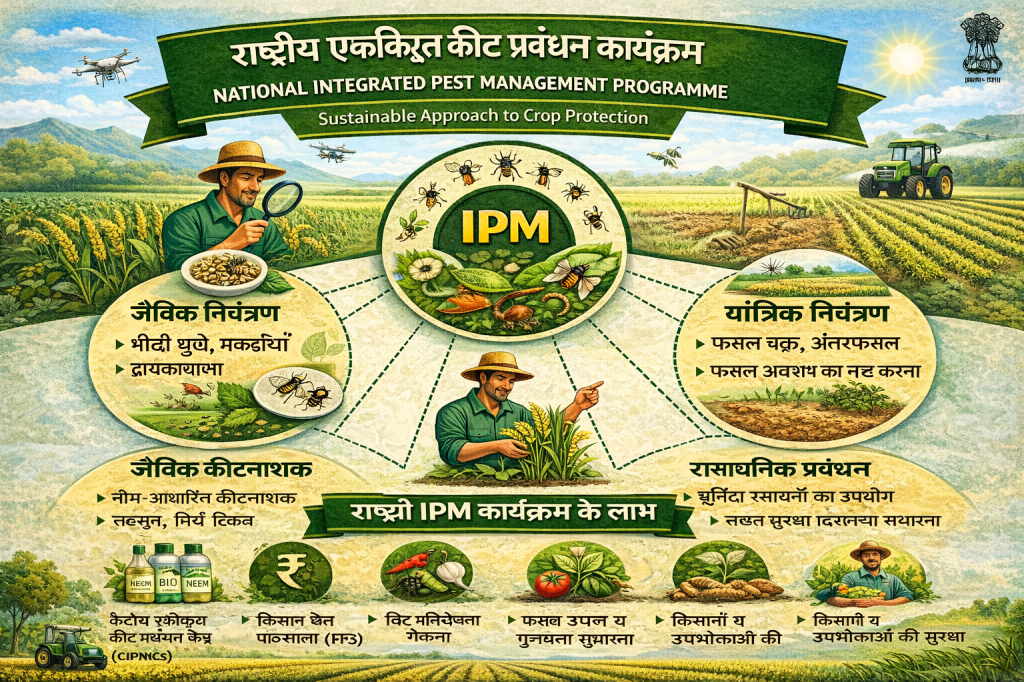
What is National IPM Programme
The National Integrated Pest Management (IPM) Programme राष्ट्रीय एकीकृत कीट प्रबंधन कार्यक्रम is a flagship initiative of the Government of India. It aims at promoting environmentally sustainable pest control practices in agriculture. The programme encourages farmers to adopt eco-friendly, cost-effective, and scientifically proven methods to manage crop pests while minimizing dependence on chemical pesticides.
The National IPM Programme plays a crucial role in ensuring safe food production, soil health conservation, biodiversity protection, and farmer safety.
Objectives of National IPM Programme (कार्यक्रम का उद्देश्य)
The main objectives of the National IPM Programme are:
- To reduce indiscriminate use of chemical pesticides
- To promote eco-friendly pest management techniques
- To keep pest populations below Economic Threshold Levels (ETL)
- To conserve natural enemies and beneficial insects
- To increase farmers’ awareness and technical knowledge
- To ensure production of residue-free agricultural produce
Concept of Integrated Pest Management (एकीकृत कीट प्रबंधन की अवधारणा)
Integrated Pest Management (IPM) is a holistic approach that combines multiple pest control strategies such as:
- Cultural methods
- Mechanical and physical control
- Biological control
- Botanical pesticides
- Judicious use of chemical pesticides (as a last option)
IPM focuses on prevention first and control later, ensuring long-term sustainability in agriculture.
Implementation Structure (राष्ट्रीय IPM कार्यक्रम का क्रियान्वयन ढांचा)
The National IPM Programme is implemented through a structured institutional mechanism:
केंद्रीय एकीकृत कीट प्रबंधन केंद्र (CIPMCs)
- The programme operates through Central Integrated Pest Management Centres (CIPMCs) located across different agro-climatic zones of India.
- These centres conduct pest surveillance, advisory services, demonstrations, and farmer trainings.
राज्य कृषि विभाग की भूमिका (Role of State Agriculture Departments)
- State governments coordinate with CIPMCs for local implementation.
- Extension officers help in farmer mobilization and field-level execution.
Pest Surveillance and Forewarning (कीट निगरानी एवं पूर्व चेतावनी प्रणाली)
A key component of the National IPM Programme is regular pest surveillance.
Activities include:
- Monitoring pest population dynamics
- Identification of emerging pest threats
- Issuing timely pest advisory bulletins
- Helping farmers take preventive measures before outbreaks occur
This system helps in reducing crop losses and unnecessary pesticide applications.
Farmer Training and Awareness (किसान प्रशिक्षण एवं जागरूकता)
किसान खेत पाठशाला (Farmer Field Schools – FFS)
- Farmers are trained directly in their fields
- Practical learning through observation and experimentation
- Emphasis on pest identification and decision-making skills
प्रशिक्षण कार्यक्रम (Training Programmes)
- Training of farmers, extension workers, and pesticide dealers
- Demonstrations on use of bio-agents, traps, and IPM tools
- Awareness campaigns on pesticide safety and residues
Promotion of Biological Control (जैविक नियंत्रण को बढ़ावा)
The National IPM Programme strongly promotes biological pest control.
Key initiatives include:
- Use of predators like ladybird beetles and spiders
- Release of parasitoids such as Trichogramma
- Promotion of microbial pesticides like Bt, NPV, and fungi
- Conservation of natural enemies in the field
This reduces chemical pesticide usage and enhances ecological balance.
Mechanical and Cultural Practices (यांत्रिक एवं सांस्कृतिक नियंत्रण उपाय)
Farmers are encouraged to adopt preventive practices such as:
- Crop rotation and intercropping
- Timely sowing and harvesting
- Field sanitation and removal of infested plant parts
- Use of pheromone traps, light traps, and sticky traps
- Installation of bird perches
These practices reduce pest buildup naturally.
Judicious Use of Chemical Pesticides (रासायनिक कीटनाशकों का विवेकपूर्ण उपयोग)
Under the National IPM Programme:
- Chemical pesticides are used only when pest levels cross ETL
- Preference is given to selective and safer pesticides
- Farmers are trained on:
- Correct dosage
- Proper spray timing
- Safety measures
- Waiting period before harvest
This approach minimizes health and environmental risks.
IPM in Major Crops (प्रमुख फसलों में IPM का कार्यान्वयन )
धान में IPM (IPM in Rice)
- Resistant varieties
- Water management
- Pheromone traps for stem borers
- Biological control agents
कपास में IPM (IPM in Cotton)
- Seed treatment with bio-agents
- Avoidance of early pesticide sprays
- Monitoring of bollworms
सब्जियों में IPM (IPM in Vegetables)
- Crop rotation
- Sticky traps for sucking pests
- Neem-based biopesticides
Benefits of National IPM Programme (राष्ट्रीय IPM कार्यक्रम के लाभ)
- Reduced cost of cultivation
- Lower pesticide residues in food
- Improved soil and environmental health
- Enhanced export quality produce
- Increased farmer income and safety
- Sustainable agricultural production
Challenges in Implementation (कार्यक्रम की चुनौतियाँ)
- Limited awareness among small farmers
- Need for regular field monitoring
- Availability of bio-agents in remote areas
- Requirement of skilled manpower
- Behavioural change from chemical-based farming
Future Outlook (भविष्य की दिशा )
The National IPM Programme is expected to gain further importance due to:
- Climate change-induced pest outbreaks
- Rising demand for organic and residue-free food
- Integration with digital agriculture and AI-based pest surveillance
- Focus on sustainable and natural farming systems
Conclusion
The National Integrated Pest Management Programme is a cornerstone of India’s sustainable agriculture strategy. By promoting eco-friendly, scientific, and farmer-centric pest management practices, the programme ensures crop protection, environmental safety, and food security. Widespread adoption of IPM is essential for achieving long-term agricultural sustainability and farmer prosperity.
 KrishiCenter
Leave a comment