
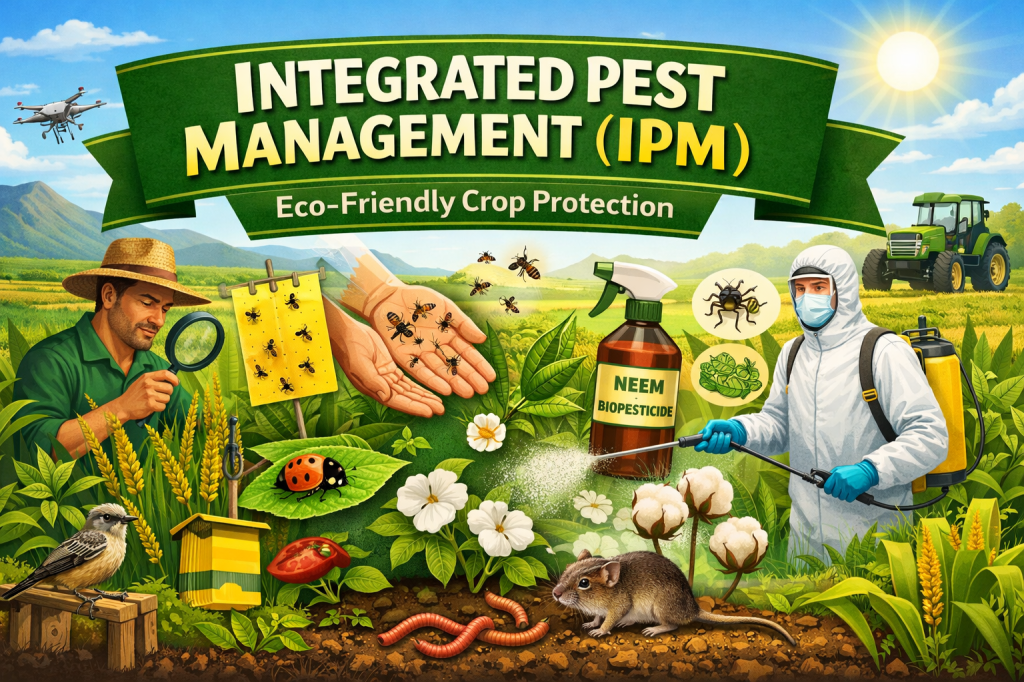
What is Integrated Pest Management (IPM)
Integrated Pest Management (IPM) is an eco-friendly strategy. It is scientifically proven for managing crop pests through a combination of biological, cultural, mechanical, and chemical methods. Instead of relying solely on pesticides, IPM emphasizes long-term prevention of pests and diseases. It ensures economic profitability, environmental safety, and human health protection.
IPM is widely promoted in Indian agriculture. The goal is to reduce excessive pesticide use and lower production costs. This practice ensures safe food production for humans and animals.
Objectives of Integrated Pest Management
The primary objectives of IPM are:
- To minimize crop losses caused by insects, diseases, weeds, and rodents
- To reduce dependency on chemical pesticides
- To maintain pest populations below Economic Threshold Levels (ETL)
- To conserve beneficial organisms like predators and parasitoids
- To protect soil, water, and biodiversity
- To ensure safe agricultural produce for consumers
Key Principles of Integrated Pest Management
IPM works on the following core principles:
1. Pest Identification
Correct identification of pests, beneficial insects, and diseases is crucial. Incorrect identification can lead to wrong pesticide use and unnecessary crop damage.
2. Pest Monitoring and Surveillance
Regular field monitoring helps farmers:
- Detect pests early
- Understand pest population trends
- Decide when and whether control measures are required
3. Economic Threshold Level (ETL)
Control measures are applied only when pest population exceeds the ETL, i.e., when economic loss is likely to occur.
4. Integrated Control Methods
Multiple control techniques are combined rather than relying on a single method.
Components of Integrated Pest Management
1. Cultural Control Methods
Cultural practices reduce pest establishment and multiplication.
Key practices include:
- Crop rotation helps soil to regain the lost nutrients
- Timely sowing and harvesting to have better yield
- Use of pest-resistant crop varieties
- Proper irrigation and nutrient management
- Intercropping and mixed cropping
- Field sanitation and destruction of crop residues
2. Mechanical and Physical Control
These methods involve direct removal or exclusion of pests.
Examples:
- Hand picking of insects and egg masses
- Use of light traps, pheromone traps, and sticky traps
- Installation of bird perches
- Use of nets, barriers, and mulches
- Deep ploughing to expose soil-borne pests
3. Biological Control
Biological control uses natural enemies to suppress pest populations.
Types of biological agents:
- Predators (ladybird beetles, spiders, lacewings)
- Parasitoids (Trichogramma, Bracon species)
- Pathogens (Bacillus thuringiensis, NPV, fungi)
Benefits:
- Environment-friendly
- No pesticide residues
- Long-term pest suppression
4. Botanical and Biopesticides
Plant-based and microbial pesticides play a major role in IPM.
Examples:
- Neem-based formulations (Azadirachtin)
- Pongamia oil
- Garlic and chilli extracts
- Microbial pesticides (Bt, Beauveria bassiana)
5. Chemical Control (Judicious Use)
Chemical pesticides are used only as a last option in IPM.
Guidelines:
- Use selective and recommended pesticides
- Apply correct dose at the right time
- Avoid broad-spectrum chemicals
- Rotate chemicals to prevent resistance
- Follow safety and waiting periods
Integrated Pest Management in Major Crops
IPM in Rice
- Use resistant varieties
- Maintain proper water management
- Install pheromone traps for stem borers
- Release Trichogramma
- Use neem products against leaf folders
IPM in Cotton
- Seed treatment with bio-agents
- Use trap crops
- Monitor bollworms with pheromone traps
- Encourage natural predators
- Avoid early pesticide spraying
IPM in Vegetables
- Crop rotation and raised nursery beds
- Use yellow sticky traps for sucking pests
- Apply neem oil sprays
- Remove infected plants promptly
Advantages of Integrated Pest Management
- Reduces pesticide residues in food
- Lowers cost of cultivation
- Prevents pest resistance
- Improves soil health and biodiversity
- Protects farmers and consumers
- Promotes sustainable agriculture
Limitations and Challenges of IPM
- Requires technical knowledge and training
- Needs regular field monitoring
- Slower action compared to chemicals
- Limited availability of bio-agents in some areas
- Farmer awareness still needs improvement
Government Support and Promotion of IPM in India
The Government of India promotes IPM through various Schemes and Programmes:
- National IPM Programme
- Farmer Field Schools (FFS)
- Central Integrated Pest Management Centres (CIPMCs)
- Training and demonstrations
- Subsidy support for bio-pesticides and traps
Role of Farmers in Successful IPM Adoption
Farmers should:
- Learn pest identification
- Monitor fields regularly
- Adopt preventive cultural practices
- Use bio-agents and botanicals first
- Avoid unnecessary pesticide sprays
- Follow expert recommendations
Future Scope of Integrated Pest Management
With increasing concerns about:
- Climate change
- Pesticide residues
- Export quality standards
- Human health and environment
IPM is expected to become the foundation of modern sustainable agriculture. Integration with digital tools, AI-based pest monitoring, and precision farming will further strengthen IPM adoption.
Conclusion
Integrated Pest Management (IPM) is a holistic, eco-friendly, and economically viable approach to pest control. By combining traditional wisdom with modern scientific techniques, IPM ensures healthy crops, safe food, and sustainable farming systems. Widespread adoption of IPM is essential for achieving long-term agricultural productivity and environmental conservation.
 KrishiCenter
Leave a comment