
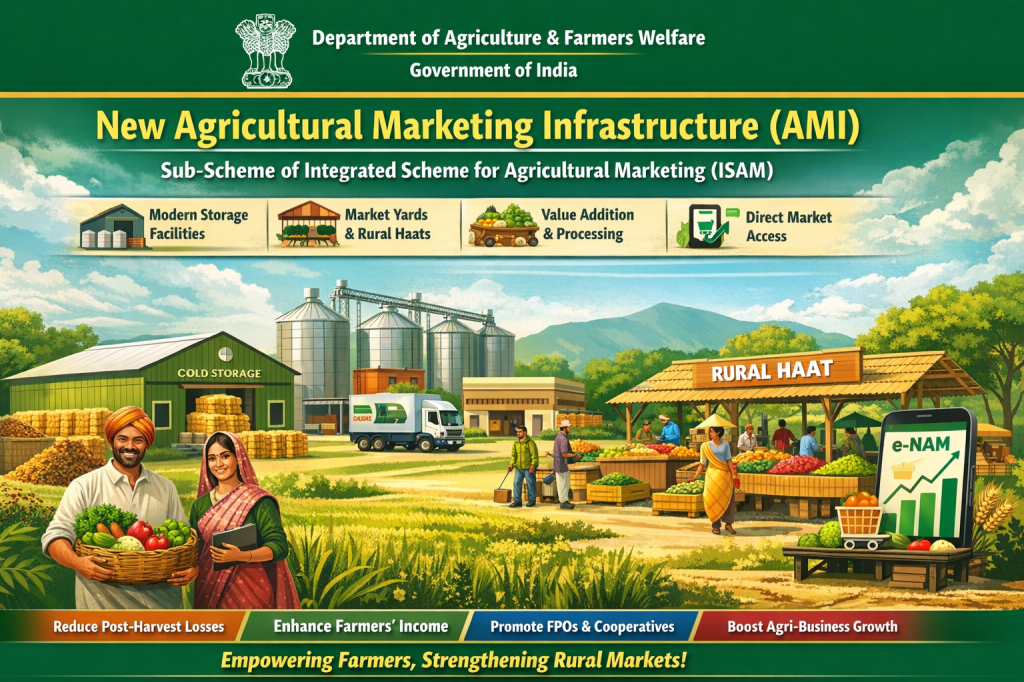
New Agricultural Marketing Infrastructure (AMI) Sub-Scheme of Integrated Scheme for Agricultural Marketing (ISAM)
The New Agricultural Marketing Infrastructure (AMI) is a capital investment–oriented sub-scheme under the Integrated Scheme for Agricultural Marketing (ISAM). It is implemented by the Department of Agriculture & Farmers Welfare, Ministry of Agriculture and Farmers Welfare, Government of India.
The scheme aims to strengthen agricultural marketing systems. It reduces post-harvest losses. It also enables farmers to store, grade, process, and market their produce efficiently. This improvement helps in income realization and market access.
Background of the Scheme
The AMI sub-scheme was formulated by merging earlier marketing infrastructure schemes, mainly:
- Grameen Bhandaran Yojana (Rural Godowns Scheme)
- Development/Strengthening of Agricultural Marketing Infrastructure, Grading & Standardisation
The merger helped create a single, comprehensive, and demand-driven framework to support agricultural marketing infrastructure across the country.
The scheme is applicable across crop, horticulture, livestock, dairy, poultry, fisheries, and minor forest produce sectors. It is operational under the current guidelines up to 31 March 2026 (subject to funding availability).
Objectives of AMI Scheme
The key objectives of the Agricultural Marketing Infrastructure (AMI) sub-scheme are:
- To create modern agricultural marketing infrastructure for storage, handling, grading, and marketing of farm produce.
- To reduce post-harvest losses through scientific storage and improved logistics.
- To promote private sector participation, cooperatives, and farmer collectives in agricultural marketing.
- To encourage direct marketing and alternative market channels, reducing the role of intermediaries.
- To improve price realization for farmers and prevent distress sales.
- To support grading, standardization, quality certification, and pledge financing using stored produce.
- To strengthen linkages between farmers and markets, including digital platforms.
Eligible Infrastructure Components
The AMI scheme supports development of the following infrastructure:
Storage Infrastructure
- Rural and semi-urban godowns
- Warehouses and scientific storage structures
- Silos (where applicable)
- Cold storage units (limited to primary handling and storage)
Market Infrastructure
- Market yards, sub-yards, and rural haats
- Farmer markets and direct marketing facilities
- Internal roads, auction platforms, loading and unloading platforms
- Boundary walls, drainage, and basic utilities within project premises
Post-Harvest & Value Addition Infrastructure
- Cleaning, grading, sorting, and packaging units
- Primary processing units (non-manufacturing)
- Drying yards and weighbridges
- Infrastructure supporting negotiable warehouse receipt systems
Support Facilities
- Quality testing and grading laboratories
- Infrastructure facilitating integration with electronic trading platforms
- Ancillary facilities essential for smooth market operations
Funding Pattern & Subsidy Structure
The AMI scheme follows a credit-linked, back-ended subsidy model.
Subsidy Rates
- 25% of the eligible project cost for general category beneficiaries in plain areas
- 33.33% of the eligible project cost for:
- Projects in hilly, North-Eastern, and notified difficult areas
- Women entrepreneurs
- Scheduled Caste (SC) and Scheduled Tribe (ST) beneficiaries
- Farmer Producer Organizations (FPOs)
Nature of Subsidy
- The subsidy is back-ended, meaning it is released after project completion and verification
- The subsidy is adjusted against the outstanding loan amount
Credit Requirement
- Projects must be financed through institutional term loans from banks or financial institutions
- Self-financed projects without bank credit are not eligible
Eligible Beneficiaries
The following entities are eligible to avail benefits under the AMI sub-scheme:
- Individual farmers and agri-entrepreneurs
- Farmer Producer Organizations (FPOs)
- Cooperative societies and federations
- State and Union Territory government agencies
- Public sector undertakings
- Private companies and MSMEs engaged in agricultural marketing
- Marketing boards and federations
Implementation Mechanism
Channelising Agencies
- NABARD acts as the primary channelising agency for release of subsidy through lending institutions
- NCDC may be involved in projects related to cooperative institutions
Monitoring & Verification
- Projects are monitored through physical inspections and documentation
- Completion certificates, geo-tagged photographs, and compliance reports are mandatory
- Subsidy is released only after verification of asset creation and loan disbursement
Benefits and Impact
For Farmers
- Improved access to storage and markets
- Reduction in distress sales
- Better bargaining power and price realization
For the Agricultural System
- Increased scientific storage capacity
- Reduced post-harvest losses
- Strengthened rural market infrastructure
Social & Economic Outcomes
- Increased participation of women, SC/ST entrepreneurs, and FPOs
- Promotion of agri-entrepreneurship and rural employment
- Improved transparency and efficiency in agricultural marketing
Current Status & Performance
The AMI sub-scheme has supported large-scale creation of rural godowns, warehouses, and market facilities across India, mobilizing substantial private and cooperative investment in agricultural marketing infrastructure.
High demand for the scheme reflects the critical need for post-harvest and marketing infrastructure. However, its implementation depends on budget availability. It is also subject to periodic guideline revisions.
Conclusion
The New Agricultural Marketing Infrastructure (AMI) sub-scheme plays a crucial role in transforming India’s agricultural marketing ecosystem. The scheme promotes scientific storage and modern markets. It encourages direct farmer participation and private investment. These actions directly contribute to enhancing farmer incomes, reducing losses, and building resilient agricultural value chains.
AMI remains a key policy instrument in achieving sustainable agricultural growth and improving market efficiency in rural India.
 KrishiCenter
Leave a comment