
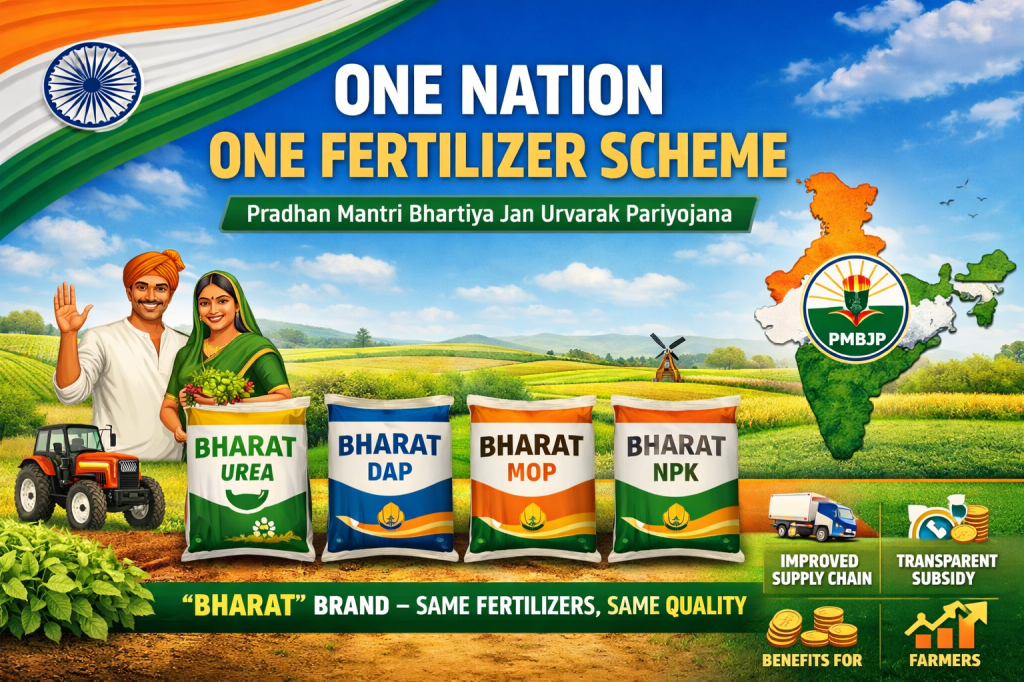
The One Nation One Fertilizer (ONOF) scheme is a major agricultural policy initiative launched by the Government of India under the Pradhan Mantri Bhartiya Jan Urvarak Pariyojana (PMBJP). It was officially rolled out on October 2, 2022 with the aim of standardizing the branding, distribution, and availability of subsidized fertilizers across the country. (Press Information Bureau)
What Is the One Nation One Fertilizer Scheme?
At its core, the **ONOF scheme mandates that subsidized fertilizers such as urea, di-ammonium phosphate (DAP), muriate of potash (MOP), and NPK be sold under a single **common brand name — “Bharat” — nationwide, regardless of the manufacturing company. (Press Information Bureau)
- Examples:
🧪 Bharat Urea,
🧪 Bharat DAP,
🧪 Bharat MoP,
🧪 Bharat NPK
Earlier, fertilizers with identical nutrient compositions were marketed under many different brand names by different companies. This practice led to confusion among farmers. It also caused varied retail practices. ONOF replaces this multiplicity with one uniform brand.
Why Was the Scheme Introduced?
1. Brand Uniformity & Clarity
Many farmers believed that different brands implied differences in quality, even for the same type of fertilizer. Fertilizers of a particular type must have the same nutrient content. This is true irrespective of the manufacturer, according to the Fertilizer Control Order. The scheme ensures farmers don’t suffer from misinformation driven by brand confusion.
2. Supply Chain Efficiency & Reduced Freight Costs
Prior to the ONOF, fertilizers were often transported criss-cross across states to meet demand, increasing logistics costs significantly. A single branding system helps optimize supply routes. It reduces transportation requirements and lowers the freight subsidy burden borne by the Government.
The Government’s objective has been to reduce the average distance fertilizers travel. They aim to decrease it significantly from roughly 700–750 km to an eventual target of around 500 km.
3. Transparency in Subsidy
Under the scheme, fertilizer bags clearly display:
- Maximum retail price
- Amount of subsidy borne by the Government
- Brand name “Bharat” and PMBJP logo
This adds transparency to the subsidy system for farmers.
Implementation of the Scheme
- ONOF was implemented from October 2022 onwards with new bag designs and branding rules.
- Fertilizer manufacturers and marketers must display the “Bharat” brand and PMBJP logo on two-thirds of the fertilizer bag. The manufacturer’s own brand and details can appear only on the remaining one-third space.
- Old inventory with previous branding was allowed to be sold until specified cut-off dates in late 2022.
Major Benefits
Farmers
- Reduced confusion about fertilizer quality and brands.
- Uniform quality expectation everywhere in the country.
- Better availability due to improved supply chain and planning.
Government
- Better control over logistics and freight subsidy spending.
- Enhanced market transparency, helping reduce black marketing or diversion.
Industry
- Helps standardize product presentation, though it may restrict individual brand marketing.
Challenges and Criticisms
Despite its goals, ONOF has drawn some concerns from industry analysts:
Manufacturer Margins & Competition
According to industry feedback, unifying brands could suppress competition. This move might squeeze manufacturer margins, especially for companies that had built strong brand loyalty over the years.
Marketing Limitations
Fertilizer producers may have to spend more on new marketing strategies because their old brand presence can no longer be prominently displayed.
Broader Impact So Far
Availability & Distribution:
Early reported impacts suggest improved supply processes and uniformness in fertilizer rolling out to the market, though long-term statistical outcomes are still emerging as the policy matures.
Farmer Perception:
With unified branding, many farmers have reported a clearer understanding that fertilizer quality is based on nutrient content (as per standards) rather than brand advertising alone — reducing psychological barriers to choosing fertilizers.
Policy Synergies:
The scheme aligns with other reforms aimed at improving agricultural input systems, such as digital subsidy workflows and potential linkage of fertilizer demands to farm size and crop data. Recent digital transformations in subsidy processing complement ONOF by enhancing transparency and reducing leakages.
Conclusion
The One Nation One Fertilizer Scheme is a significant structural reform in India’s agricultural sector. The initiative standardizes fertilizer branding. It improves supply chain efficiency. Additionally, it boosts transparency in subsidies. These efforts address long-standing challenges in fertilizer distribution and farmer welfare. While it poses strategic adjustments for manufacturers and market stakeholders, its long-term effects are expected to stabilize the fertilizer market and benefit farmers nationwide.
 KrishiCenter
Leave a comment