
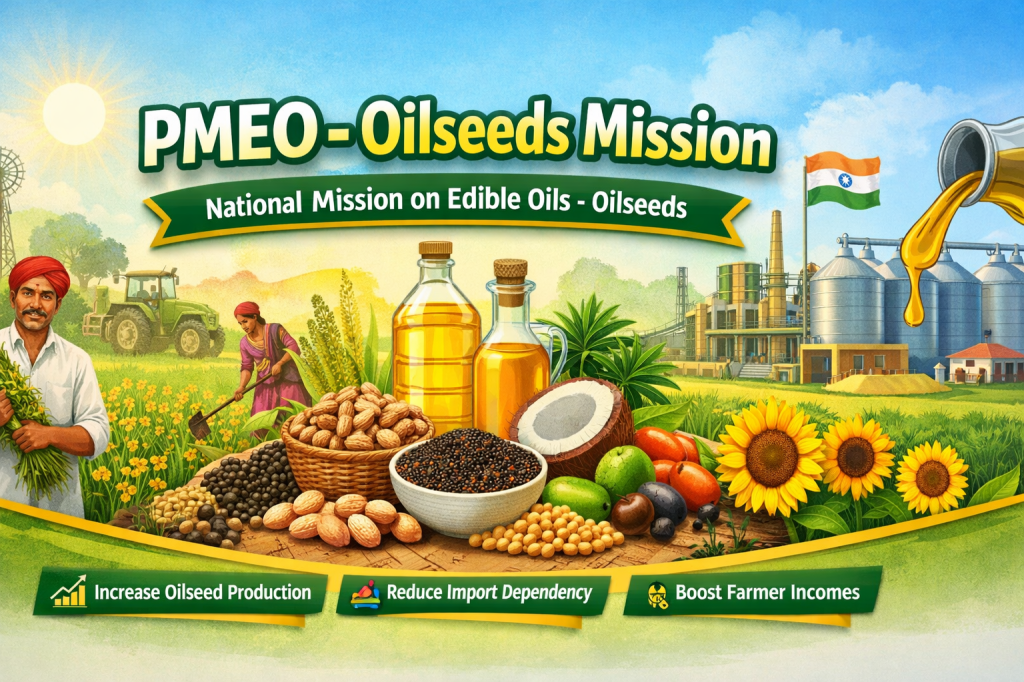
What is National Mission on Edible Oils?
The PMEO – Oilseeds Mission, officially named the National Mission on Edible Oils – Oilseeds (NMEO-Oilseeds), is a flagship Government of India scheme launched in 2024 to address one of India’s most critical agricultural and economic challenges—dependence on imported edible oils.
India is the world’s largest importer of edible oils. The country spends thousands of crores every year on imports of palm oil, soybean oil, and sunflower oil. India has suitable agro-climatic conditions and a long history of oilseed cultivation. However, domestic production has not kept pace with growing demand. The Oilseeds Mission aims to reverse this trend by strengthening the entire oilseed value chain—from seed to market.
Background & Need for the Mission
India’s Edible Oil Scenario
- Domestic edible oil demand is rising rapidly due to:
- Population growth
- Changing food habits
- Rising incomes
- More than 55–60% of edible oil consumption is met through imports.
- Import dependency exposes India to:
- Global price volatility
- Foreign exchange outflow
- Supply chain disruptions
Challenges in Oilseed Production
- Low productivity compared to global averages
- Use of old and low-yielding varieties
- Rain-fed cultivation and climate risks
- Fragmented landholdings
- Inadequate post-harvest and processing infrastructure
The Oilseeds Mission was designed as a long-term structural solution to these challenges.
Mission Duration & Financial Outlay
- Implementation Period: 2024-25 to 2030-31
- Total Budget: ₹10,103 crore
- Implemented under the Krishonnati Yojana umbrella
The mission adopts a results-oriented and district-focused approach instead of short-term production pushes.
Vision & Core Objectives
Increase Oilseed Production
- Raise total oilseed production from ~39 million tonnes (2022-23) to ~69.7 million tonnes by 2030-31
- Improve national average yield through better seeds and agronomic practices
Reduce Import Dependence
- Along with NMEO–Oil Palm, the mission aims to meet over 70% of India’s edible oil requirement domestically
- Reduce vulnerability to global market fluctuations
Expand Area Under Oilseeds
- Bring an additional 40 lakh hectares under oilseed cultivation
- Focus on:
- Fallow lands
- Intercropping systems
- Crop diversification from water-intensive crops
Increase Farmers’ Income
- Lower cost of cultivation
- Better yields and quality
- Improved market linkages and processing access
Crops Covered Under the Mission
Primary Oilseeds
- Rapeseed & Mustard
- Groundnut
- Soybean
- Sunflower
- Sesamum (Til)
Other Oilseeds
- Safflower
- Niger
- Linseed
- Castor
Secondary Sources of Edible Oil
- Rice bran oil
- Cottonseed oil
- Coconut oil
- Tree-borne oilseeds
This diversified approach ensures regional suitability and resilience.
Major Components of the Mission
Seed System Strengthening
Seed availability is the foundation of oilseed productivity.
Key interventions:
- Development of high-yielding and high oil-content varieties
- Promotion of climate-resilient and stress-tolerant seeds
- Use of modern breeding tools including genome editing
- Establishment of:
- 65 Seed Hubs
- 50 Seed Storage Units
SATHI Portal
- Seed Authentication, Traceability & Holistic Inventory system
- Enables:
- Quality control
- Transparent seed distribution
- Five-year rolling seed planning
Cluster-Based Approach
- Creation of 600+ oilseed clusters across 347 districts
- Each cluster focuses on:
- Demonstration of best practices
- Access to quality inputs
- Farmer training and advisory services
- Promotes localized solutions instead of one-size-fits-all strategies
Improved Agronomic Practices
- Promotion of:
- Line sowing
- Balanced fertilization
- Integrated pest and disease management
- Mechanization and precision farming
- Encourages water-efficient practices, especially in rain-fed regions
Post-Harvest & Processing Infrastructure
To increase oil recovery and farmer returns:
- Support for:
- Oil expellers
- Mini oil mills
- Modern processing units
- Focus on reducing:
- Post-harvest losses
- Transportation costs
- Value addition at local and regional levels
Role of FPOs & Private Sector
- Strong involvement of:
- Farmer Producer Organizations (FPOs)
- Cooperatives
- Startups and private processors
- Encourages:
- Aggregation of produce
- Better bargaining power
- Direct market access
Awareness & Capacity Building
- Large-scale IEC (Information, Education & Communication) campaigns
- Farmer training on:
- Modern oilseed cultivation
- Market trends
- Nutrition and edible oil awareness
- Encourages informed consumer choices and healthier diets
Expected Outcomes & Impact
Agricultural Impact
- Higher oilseed productivity
- Increased cropping intensity
- Better resilience to climate risks
Economic Impact
- Reduced edible oil import bill
- Increased farmer income
- Growth of rural agro-processing industries
Social & Environmental Impact
- Employment generation in rural areas
- Sustainable use of land and water
- Improved soil health through crop diversification
Strategic Importance for India
The PMEO – Oilseeds Mission is not just an agricultural program—it is a national economic and food security initiative that supports:
- Atmanirbhar Bharat
- Farmer welfare
- Long-term price stability
- Sustainable agriculture
Conclusion
The PMEO – Oilseeds Mission represents a paradigm shift in India’s approach to edible oil self-sufficiency. By integrating technology, infrastructure, farmer participation, and policy support, the mission aims to create a robust, competitive, and sustainable oilseed ecosystem.
If implemented effectively, it has the potential to transform India from a major edible oil importer into a largely self-reliant nation. This change could significantly improve the livelihoods of millions of farmers.
 KrishiCenter
Leave a comment