
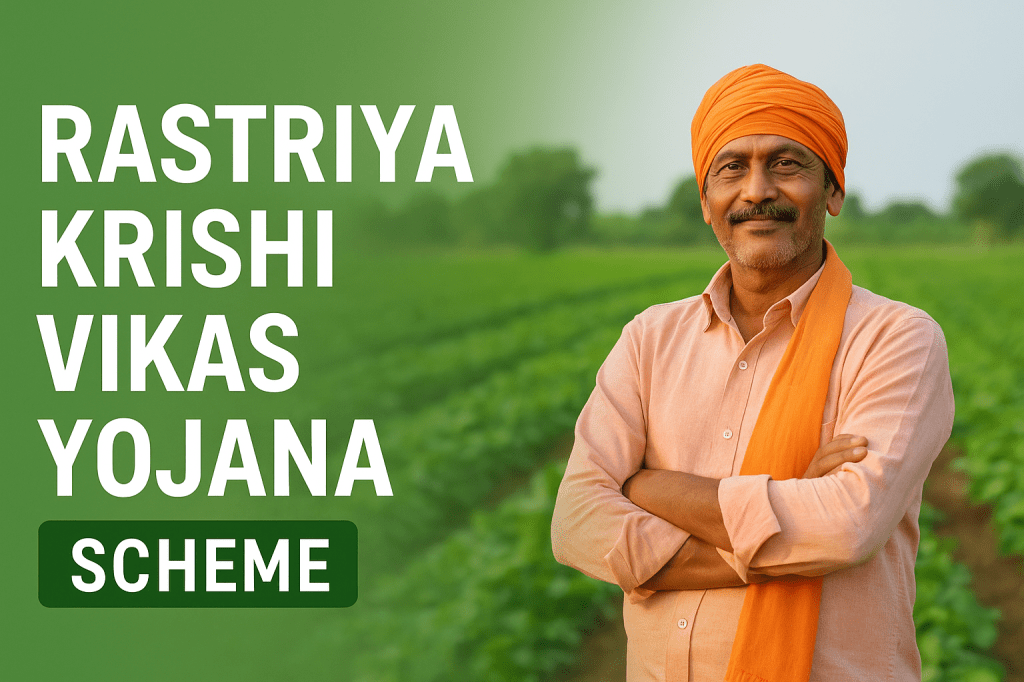
What is Rashtriya Krishi Vikas Yojana?
RKVY is a centrally sponsored scheme launched in 2007-08. It aims to promote holistic development in agriculture and allied sectors. This is achieved by encouraging states to distribute higher resources. It focuses on innovation, infrastructure, value chain development, and improving farmers income. The scheme focuses on:
Ensuring holistic agricultural growth
Encouraging need-based planning
Promoting innovation, infrastructure, and technology adoption
Enhancing farm income and production efficiency
Firstly it was named RKVY, it was later redesigned as RKVY-RAFTAAR (Remunerative Approaches for Agriculture and Allied sector Rejuvenation) in 2017-18, giving more importance to innovation, incubation, value chain development, and entrepreneurship to match with the growing digital pace in today’s world.
RKVY – Why DPR-Based Approach?
The importance of a Detailed Project Report (DPR) holds in planning, implementing, and monitoring RKVY projects to have meaningful implementation. A DPR ensures:
- Scientific planning & technical justification
- Clear financial layout
- Feasibility evaluation
- Outcome-based execution
- Transparency & accountability
- Maximization of farmer benefit
Thus, DPR acts as the backbone of project approval and funding. DPR ensures scientific planning, feasibility analysis, financial clarity, and outcome-based project execution. It justifies the need, reduces risks, and ensures transparency in how funds are utilized.
RKVY DPR-value creation-krishicenter
Key Components of RKVY (DPR-Based Sub-Schemes)
This section outlines the broad categories of activities and projects supported under RKVY through DPRs.
RKVY supports infrastructure creation and agriculture value chains. It enhances post-harvest management and agri-entrepreneurship. RKVY also promotes animal husbandry and fisheries. It encourages special innovations and digital agriculture through DPR-based proposals.
Agricultural Infrastructure Development
Describes major infrastructure projects that improve farm productivity and mechanization. Includes CHCs, farm machinery banks, micro-irrigation systems, protected cultivation, soil testing labs, and organic resource centers.
Custom Hiring Centers (CHCs)
Farm Machinery Banks
Rural pack-houses and grading units
Irrigation structures (minor irrigation, micro irrigation)
Protected cultivation (polyhouses, shade nets)
Soil testing laboratories
Organic resource management centres
Value Chain & Supply Chain Projects
Covers activities that strengthen farm-to-market linkages and reduce post-harvest losses. Includes collection centers, cold storage, processing units, packhouses, and logistics improvement for perishables.
Collection and processing centers
Warehouses, cold storages, and reefer vans
Primary processing units for fruits, vegetables & millets
Packhouses for FPOs
Agri-logistics improvement
Agri-Entrepreneurship Development
Focuses on startup incubation and innovation support under RKVY-RAFTAAR. Includes funding for agri-startups, incubation centers (R-ABIs), and pilot innovations.
Support to agri startups
Incubation centers under R-ABI (RKVY-Agribusiness Incubators)
Innovation & pilot project funding
Project RKVY Agri startup – krishicenter
Animal Husbandry & Fisheries Projects
Highlights DPR projects that promote dairy, poultry, goatery, and aquaculture development. Includes dairies, fish ponds, poultry sheds, fodder development, and hatcheries.
Dairy processing units
Milk chilling plants
Fodder development
Poultry sheds
Goat farming clusters
Fish seed rearing units
Aquaculture ponds
Special Projects
Covers state-specific innovative proposals under RKVY. Includes digital agriculture tools, climate-resilient farming, tribal support initiatives, and crop diversification models.
Digital agriculture
Precision farming
Crop diversification
Climate-resilient farming models
Tribal farmer support projects
Detailed Project Report (DPR) – Structure Under RKVY
It explains the standardized format and essential components required to prepare a DPR for RKVY funding. Please find below the standard RKVY-compliant DPR structure used by state government bodies:
Executive Summary
A concise overview of the project’s purpose, beneficiaries, cost, and expected outcomes.
Need of the project
Key objectives
Target beneficiaries
Expected outcomes
Total project cost & funding pattern
Introduction & Background
Provides the context, current challenges, and justification for the project.
State and district agricultural profile
Challenges & gaps (productivity, infrastructure, marketing)
Rationale for the proposed intervention
Project Objectives
Defines what the project aims to achieve in terms of productivity, income, and sustainability.
Enhancing productivity
Income generation for farmers
Resource-use efficiency
Reducing post-harvest losses
Strengthening value chains
Project Components
Detailed description of activities, technical specifications, and cost norms involved in the project.
Technical specifications
Equipment list
Cost norms
Implementation workflow
Technical Feasibility
Focuses on resource availability, technology suitability, and market potential.
Resource availability
Technology suitability
Market analysis
Site analysis
Assumptions made
Financial Analysis
Covers cost estimates, revenue projections, profitability, and economic viability.
Capital cost
Recurring cost
Working capital
Revenue projections
Profitability analysis
Payback period
Cost-benefit ratio (CBR)
Implementation Mechanism
Explains agencies involved, timelines, procurement plans, and monitoring systems.
Implementing agency (Department/ATMA/FPO/NGO/startup)
Timeline of activities
Procurement plans
Monitoring & evaluation system
Risk Assessment & Mitigation
Identifies potential risks such as climate, market, and production, along with solutions.
Climate risks
Market volatility
Production risks
Socio-economic risks
Sustainability Plan
Shows how the project will generate long-term benefits, maintain infrastructure, and remain economically viable.
Long-term revenue model
Farmer ownership
Environmental sustainability
Funding Pattern Under RKVY
This section explains how the project cost is shared between the central and state governments under different categories. Funding is shared in 60:40 (states), 90:10 (NE/Himalayan states), and 100% (UTs) ratios.
For Most States
- 60:40 (Central : State)
For Himalayan & NE States
- 90:10
For UTs (without legislature)
- 100% Central funding
Projects are approved by:
State Level Sanctioning Committee (SLSC)
Department of Agriculture & Farmers Welfare (DA&FW), GoI
Type of DPR-Based Projects Supported Under RKVY
Provides examples of various kinds of DPRs that can be prepared and funded under the scheme.
On-Farm Production Enhancement
Focuses on increasing crop productivity through improved seeds, precision farming, and integrated farming.
High yielding seed production units
Integrated farming systems (IFS)
Precision farming & sensor-based irrigation
Organic & natural farming clusters
Post-Harvest Management
Helps reduce losses and ensure value addition through processing and cold chain infrastructure.
Cold chain projects
Sorting/grading lines
Mobile processing units
Millet-based value addition units
Market & Value Chain
Strengthens market access, branding, and logistics for agricultural products.
E-market platforms
FPO-led processing plants
Agri-logistics improvement
Packaging & branding units
Rural Infrastructure
Includes rural haat upgradation, veterinary services, soil testing, and fish landing centers.
Rural haat upgradation
Soil health card infrastructure
Veterinary clinics
Fish landing centers
Agri-Startup & Innovation
Promotes new technologies, incubation support, drones, and AI-based agricultural solutions.
Biotechnology labs
Drone service centers
AI-based advisory systems
Smart warehousing systems
What are the Benefits of RKVY-DPR Based Schemes
It encourages to build a sytematic approach in growing agrcultural economy. Its implementation helps farmers, states, and the nation as a whole from DPR-driven agricultural development.
To Farmers
- Increased income
- Reduced production cost
- Better access to technology
- Market linkage enhancement
- Skill development
To States
- Boost in agriculture GDP
- Improved infrastructure
- Strengthening of FPOs
- Reduction in post-harvest losses
To Nation
- Enhanced food security
- Improved export competitiveness
- Rural employment generation
Project RKVY – krishicenter
How to Prepare RKVY DPR?
You can find the easy to adopt step by step guide on how to prepare detailed Project Report. It provides a clear eight-step method to prepare a successful DPR for approval.
Step 1: Identify need-based project
Consult local stakeholders, FPOs, Krishi Vigyan Kendras (KVKs), and district agriculture offices.
Step 2: Conduct baseline survey
Generate data on production, markets, constraints.
Step 3: Define objectives & outcomes
Step 4: Prepare technical design
Specifications, layout, technology, equipment.
Step 5: Prepare cost estimates
Follow RKVY & NABARD cost norms.
Step 6: Financial feasibility analysis
CBR, IRR, sensitivity analysis.
Step 7: Draft DPR
Prepare complete document (50–150 pages depending on project).
Step 8: Submit to SLSC for approval
Sample RKVY DPR Titles (You Can Request Any of These)
Here is a PDF sample DPR Detailed project Report for “RKVY-Polyhouse-DPR” for review. You can contact for Ready-to-develop DPR topics for agriculture, horticulture, dairy, fisheries, and FPOs.
Agriculture
- Polyhouse & Drip Irrigation Project DPR
- CHC (Custom Hiring Centre) DPR
- Seed Processing Plant DPR
- Organic Input Production Unit DPR
Horticulture
- Mango Packing & Ripening Unit DPR
- Vegetable Collection Centre DPR
- Floriculture & Greenhouse DPR
Animal Husbandry
- Dairy Processing Mini Plant DPR
- Goatery Cluster DPR
- Poultry Layer Unit DPR
Fisheries
- Recirculatory Aquaculture System (RAS) DPR
- Fish Seed Hatchery DPR
FPO/FPC
- FPO Value Addition Infrastructure DPR
- Primary Processing Centre DPR
Conclusion
The Rashtriya Krishi Vikas Yojana (RKVY) plays a defining role in Indian agriculture. It uses DPR-based scientific methods. The approach is outcome based in planning and implementation.
RKVY encourages states to adopt technology. It supports value chain development and agri-entrepreneurship. The scheme also promotes farmer-centric infrastructure. As a result, RKVY has become one of India’s most comprehensive schemes for rural and agricultural growth.
A well-prepared DPR ensures that resources are utilized effectively. The intended benefits reach farmers. This makes agriculture profitable, resilient, and future-ready.
 KrishiCenter
Leave a comment